If you have already Googled this question, you have surely come across such translation variations of the phrase Capital gains, such as “added value”, “incremental value” or even “capital gain”. In fact, in Portuguese, this expression originates from the Marxist political economy term "surplus value".
Given the constant rise in property prices, you will make a profit upon sale, so let's figure out how to avoid or reduce this tax, how it is calculated and how to file the return.
Who is exempt from profit tax on the sale of real estate?
Exemption applies in the following cases:
- The property was acquired before 1989.
- A person aged over 65 or in receipt of a pension invests the funds received into a pension fund within six months of the date of sale.
- If you sold your own home and are reinvesting the full amount into new housing for yourself or your family, or towards the construction / reconstruction of such housing, within 36 months. At the same time, if you bought yourself new housing within the 2 years prior to the sale and only then sold the old one, this also counts.
If reinvestment is partial, the exemption applies to the reinvestment amount.
In other cases, be prepared to share your profits with the state.
How to calculate and reduce capital gains (mais-valias)?
You must deduct from the sale price all costs incurred in upgrading your property over the last 12 years, provided you can provide documentary evidence of these costs. You should also deduct the estate agent’s commission of 5%. You should also deduct the IMT you paid (transfer tax) and the government duty of 0.8%.
The purchase cost of the property needs to be adjusted by the inflation coefficient published by government. That is, the purchase price is considered adjusted: 1000 euros from the year 2000 is today's 1420 euros, and from 2010 it's 1100€.
Let's consider a specific example:
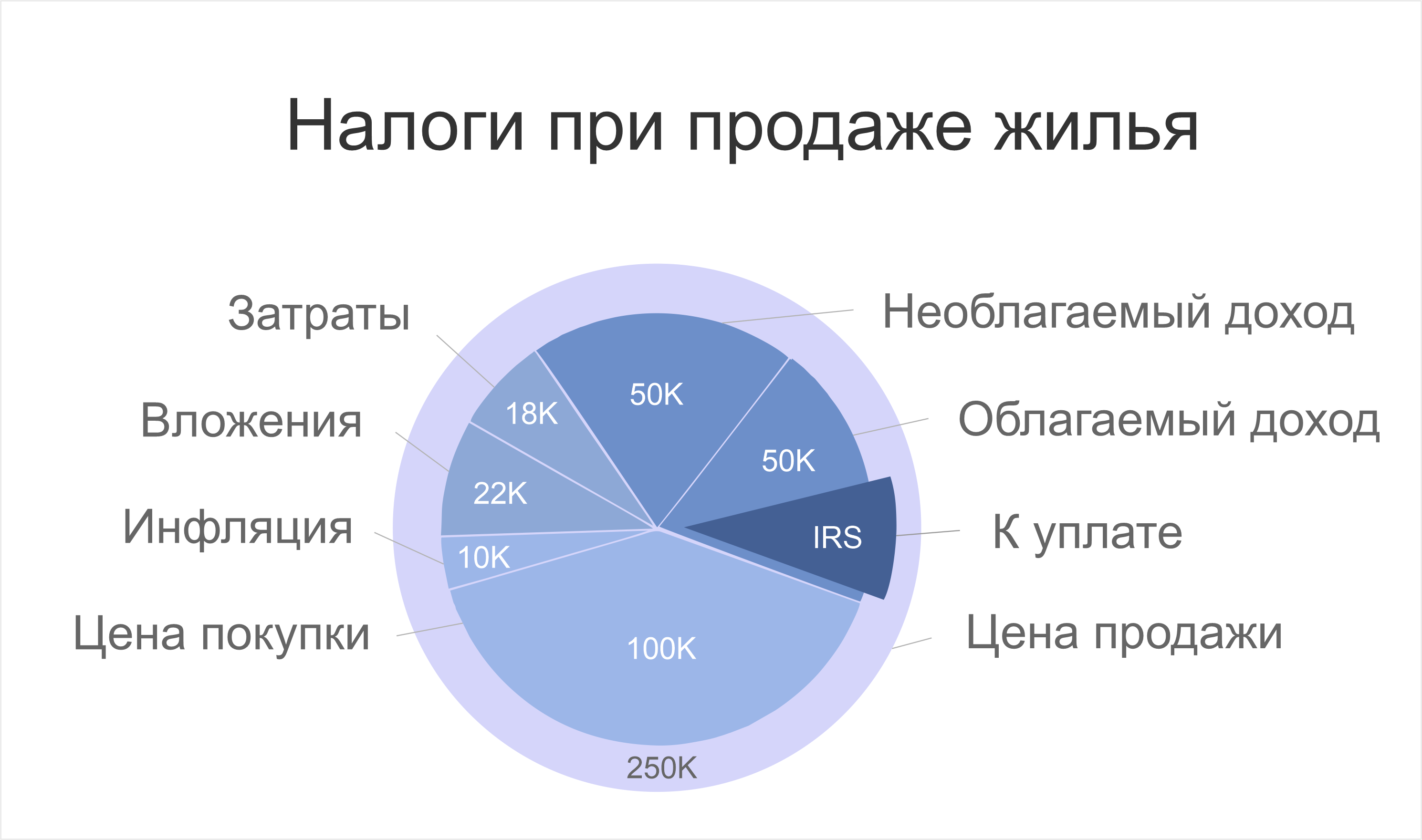
The flat was bought in 2010 for €100,000, which taking inflation into account is €110,000. In 2022 it is being sold for €250,000. There were two refurbishments in the flat and window replacement amounting to €22,000. Taxes and fees paid: €2,000 upon purchase and €16,000 upon sale. This results in a profit of €250,000 – €110,000 – €22,000 – €18,000 = €100,000.
If you are a non-resident or this is not your primary residence, then tax will have to be paid on all amounts.
If this flat is your home, then it is subject to tax 50% amounts, i.e., €50,000 from the example above.
To the resulting amount, you also add your other income, for example, your salary. And from the final amount, you determine the tax rate at which you will pay IRS (income tax), which in Portugal reaches a progressive scale of 48%. However, of course, taking into account the amounts of tax deductions if you work in Portugal. If both spouses work, filing a joint return will most likely be more advantageous in terms of tax deductions.
Thus, reinvesting in your own home allows you to avoid mais valias. Furthermore, this rule applies not only within the territory of Portugal, but across the entire Eurozone.