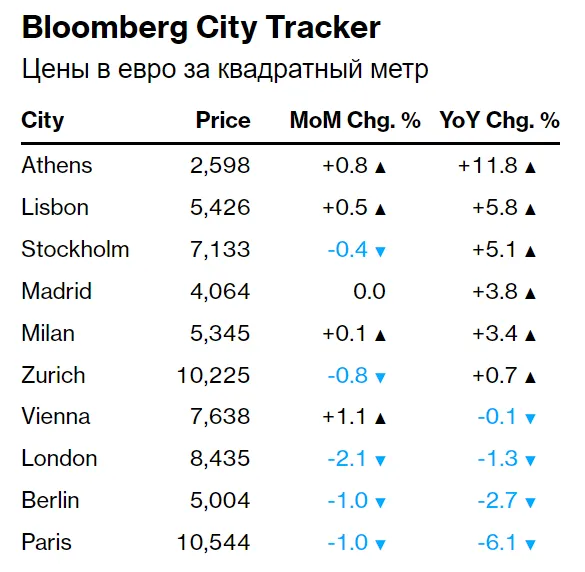
According to Idealista, house prices in Lisbon rose by 5.8% in November to a record high of 5,426 euros per square metre. This is the second-highest increase in Europe after Athens, the hottest property market among major European cities tracked by Bloomberg.
Following an increase of nearly 30% over the past five years, residential property in the Portuguese capital is more expensive than in Milan, Madrid and Berlin.
The Portuguese government has begun to reverse course, ending the golden visa scheme and cutting tax breaks for new residents. Yet with a sunny climate and prices half those of Paris and Zurich, efforts to curb demand are having little effect.
«Despite these changes, we are seeing an increase in the number of enquiries from our international clients,» says Paulo Silva from Savills Portugal. «There simply aren't enough homes to meet demand, even though sales have slowed down.».
Whilst the end of the era of cheap money has hit purchasing power across Europe, a shortage of supply is driving up prices in many cities. In Athens, the year-on-year increase is approaching 12%, in Stockholm, growth exceeds 5%, marking six consecutive months of growth, whilst prices in Madrid and Milan continue to rise steadily at a rate of over 3%. Paris recorded the weakest performance, with a fall of more than 6%.
Lisbon, once a property backwater dotted with dilapidated buildings, became an investment hotspot after the end of international bailouts in 2014. At the time, the government lifted rent controls and introduced the golden visa — a way to obtain residency in exchange for €500,000 in real estate investment — as well as tax breaks to attract new residents.
Shortly after this, thousands of foreign buyers arrived in Lisbon looking for bargains as the country recovered from the financial crisis. Among them was the Swiss billionaire Claude Berda, founder of the French broadcasting company AB Groupe. In 2016, he formed a partnership with local investor José Cardoso Botelho to buy their first plot of land on one of Lisbon's seven hills.

They founded Vanguard Properties in Lisbon and have since built nearly a dozen residential developments in the city of half a million people. Demand was so strong that they frequently sold out even before they were built.
Cardoso Botelho says that the long wait for construction permits (eight years for one of his sites) has led to a severe shortage. Red tape means that Vanguard has no apartments to put on the market next year following the handover of 500 apartments over the last two months — almost half of which went to foreign buyers.
According to Confidencial Imobiliario, the number of available homes in Portugal reached a 15-year low in 2022. Meanwhile, according to the Deloitte Property Index, the average price of a new home in Lisbon overtook Dublin and Brussels. For many Portuguese families, whose wages are among the lowest in Western Europe, the dream of buying a home has been replaced by expensive and poor-quality rental housing in remote suburbs.
Lisbon's trends show just how difficult it is for governments to control housing prices. Although demand can be stimulated through incentives, boosting supply takes time and money, and disrupting the balance can lead to boom-and-bust cycles.
There are growing concerns that the current rise in prices may soon come to an end. The Bank of Portugal stated last month that lenders would have to build up additional capital buffers to cover potential losses related to the housing market. This move came after house sales in Portugal fell by 22% in the first six months of the year, according to JLL.